Predicting the Future of AI
Where are we going with this?
Predicting the Future of AI
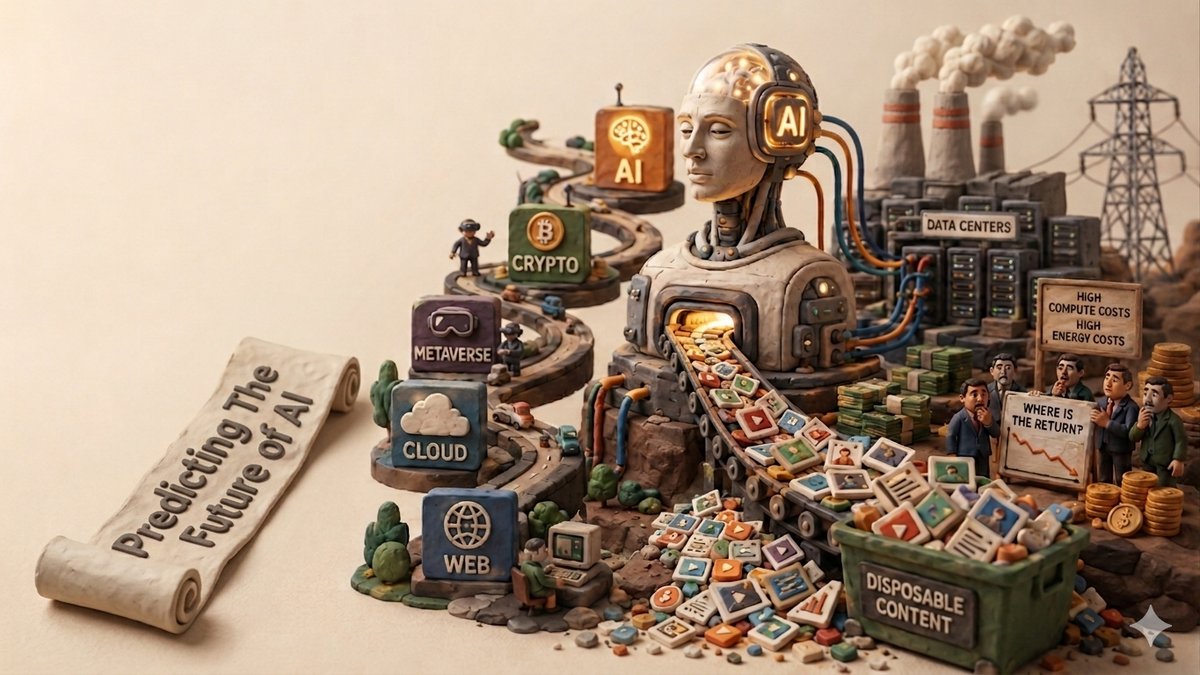
AI is the new crypto, which was the new metaverse, which was the new cloud, which was the new web. Technology continues to advance at a rapid pace, and those of us in this space must remain curious learners. The real work is to move beyond the hype cycle and find where the actual value lives.
Despite the current narrative, AI is not particularly new. What we are seeing today is not necessarily “intelligence” in the way most people understand the word, unless the emphasis is placed heavily on artificial. The term “artificial intelligence” dates back to the 1950s, likely before most people reading this were born.
Large Language Models (LLMs) have become the dominant technology receiving the AI label today. At their core, these systems are trained to predict likely continuations based on patterns in massive amounts of data. This pattern-matching is fundamentally different from human reasoning, judgment, or logic. It would require a fundamental paradigm shift, not merely an incremental leap for the current iterations of this technology to be considered true intelligence.
Right now, the industry is at an inflection point. Billions of dollars are being poured into companies developing and improving these technologies, and much of that money is being spent on depreciating infrastructure and high ongoing compute costs. In many cases, those dollars are being converted into content with no lasting value: generated text, images, summaries, and outputs that may be viewed once, if at all, and then discarded.
Eventually, the capital propping up this experiment will face a harder question: Where is the return?
OpenAI, the maker of ChatGPT, has already explored ways to close the gap between what these systems cost to operate and what they bring in. In January 2026, OpenAI announced plans to begin testing ads in ChatGPT, with the test beginning in February for some Free and Go tier users. In theory, this enshittification will create a new revenue stream, but ethical concerns, privacy concerns, and product friction may still weigh it down.
The majority of revenue in this market still comes from subscriptions, enterprise agreements, and API usage. But are those costs sustainable for companies that are not seeing meaningful returns on their AI investments? We are currently in the era of “our CEO says we need to use AI.” But when those bills come due and the business value is unclear, why would companies continue paying at the same level?
Adding to the challenge, LLM economics do not cleanly follow the traditional software model. Once conventional software is built, the marginal cost of distributing it is generally very low. LLMs are different. Every prompt, every generated image, every automated workflow, and every agentic task consumes compute. Larger data centers create some operational efficiencies, but they do not eliminate the basic problem: usage continues to carry a real infrastructure and energy cost.
That means the industry turns energy and compute into garbage. Generated text that cannot be fully relied upon for accuracy, or cute images created for a moment of social media attention, become immediately basura upon creation.
The Bold Prediction
General-purpose LLM use will become cost-prohibitive for average companies and users. Companies building AI wrappers on top of someone else’s model will face pressure from both sides: the model provider can replicate their product, and rising usage costs will make their margins unsustainable.
My prediction is that the largest negative swings in this industry will arrive in 2028. SaaS companies, social media platforms, and other tech companies will be scrambling not only to justify AI spend, but also to retain and develop technical talent. Junior talent is not being nurtured at the same rate, while senior talent is retiring, consolidating, or being absorbed into fewer companies.
The hype will fade and software engineering will become more valuable and necessary than ever.
AI is the new crypto, which was the new metaverse, which was the new cloud, which was the new web. Technology continues to advance at a rapid pace, and those of us in this space must remain curious learners. The real work is to move beyond the hype cycle and find where the actual value lives.
Despite the current narrative, AI is not particularly new. What we are seeing today is not necessarily “intelligence” in the way most people understand the word, unless the emphasis is placed heavily on artificial. The term “artificial intelligence” dates back to the 1950s, likely before most people reading this were born.
Large Language Models (LLMs) have become the dominant technology receiving the AI label today. At their core, these systems are trained to predict likely continuations based on patterns in massive amounts of data. This pattern-matching is fundamentally different from human reasoning, judgment, or logic. It would require a fundamental paradigm shift, not merely an incremental leap for the current iterations of this technology to be considered true intelligence.
Right now, the industry is at an inflection point. Billions of dollars are being poured into companies developing and improving these technologies, and much of that money is being spent on depreciating infrastructure and high ongoing compute costs. In many cases, those dollars are being converted into content with no lasting value: generated text, images, summaries, and outputs that may be viewed once, if at all, and then discarded.
Eventually, the capital propping up this experiment will face a harder question: Where is the return?
OpenAI, the maker of ChatGPT, has already explored ways to close the gap between what these systems cost to operate and what they bring in. In January 2026, OpenAI announced plans to begin testing ads in ChatGPT, with the test beginning in February for some Free and Go tier users. In theory, this enshittification will create a new revenue stream, but ethical concerns, privacy concerns, and product friction may still weigh it down.
The majority of revenue in this market still comes from subscriptions, enterprise agreements, and API usage. But are those costs sustainable for companies that are not seeing meaningful returns on their AI investments? We are currently in the era of “our CEO says we need to use AI.” But when those bills come due and the business value is unclear, why would companies continue paying at the same level?
Adding to the challenge, LLM economics do not cleanly follow the traditional software model. Once conventional software is built, the marginal cost of distributing it is generally very low. LLMs are different. Every prompt, every generated image, every automated workflow, and every agentic task consumes compute. Larger data centers create some operational efficiencies, but they do not eliminate the basic problem: usage continues to carry a real infrastructure and energy cost.
That means the industry turns energy and compute into garbage. Generated text that cannot be fully relied upon for accuracy, or cute images created for a moment of social media attention, become immediately basura upon creation.
The Bold Prediction
General-purpose LLM use will become cost-prohibitive for average companies and users. Companies building AI wrappers on top of someone else’s model will face pressure from both sides: the model provider can replicate their product, and rising usage costs will make their margins unsustainable.
My prediction is that the largest negative swings in this industry will arrive in 2028. SaaS companies, social media platforms, and other tech companies will be scrambling not only to justify AI spend, but also to retain and develop technical talent. Junior talent is not being nurtured at the same rate, while senior talent is retiring, consolidating, or being absorbed into fewer companies.
The hype will fade and software engineering will become more valuable and necessary than ever.
Comments (0)
No comments yet — be the first to share your thoughts.
Leave a Comment
Your comment will be visible after review.