Website Development
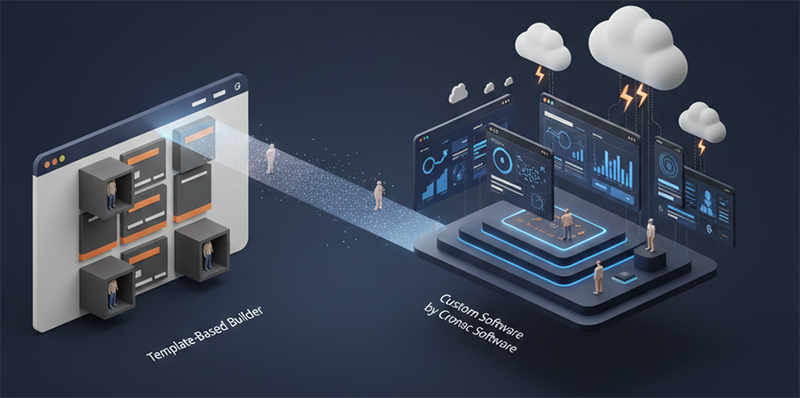
Website Builder vs. Custom Website
Learn the advantage of custom software over common builders
Overview
As mentioned in the pricing article, many website builders exist that allow for drag-and-drop elements and prebuilt designs. These are great platforms for a new business to have a website on the web quickly and at reasonable cost. The real issues start to arise when you business eventually outgrows the capabilities of those platforms because ultimately they are limited.
Why do businesses outgrow builders?
Website builders must remain generic to support a wide range of users.
Need a contact page? Easy.
A homepage with marketing text and images? Built in.
But businesses eventually require functionality beyond standard templates, such as:
Secure Customer Portals: Private login areas for clients.
Interactive Data: Personalized dashboards or custom map integrations.
Proprietary Workflows: Unique logic that matches your specific business operations.
System Integration: Seamless communication with internal business software.
For example, a company may want customers to log in and interact with a tailored Google Map, or have website activity feed internal operational software. These types of requirements move beyond website configuration and into custom software engineering, which website builders are not designed to support.
The Hidden Cost and Risks of "Plug-in Bloat"
Website builders often require a patchwork of third-party plug-ins and additional subscriptions to achieve specific goals. This creates several long-term issues:
1. Maintenance Cycles: Open-source or third-party plug-ins require constant updates to stay functional.
2. Security Vulnerabilities: Highly popular plug-ins are frequent targets for "bad actors." Using "off-the-shelf" tech makes your vulnerabilities easily discoverable.
3. Reputational Risk: A compromised site leads to more than just downtime; it results in a loss of consumer trust that can take years to rebuild.
Ownership and Platform Dependency
One of the least discussed aspects of website builders is platform ownership.
In many builder ecosystems, the website is tightly coupled to the hosting platform. This means businesses cannot easily move their site to another provider or fully control how their software operates.
With a custom solution from Cronac Software, the website and underlying code belong to the business. Organizations retain the flexibility to host, modify, or migrate their platform as their needs evolve.
This approach reduces vendor lock-in and supports long-term digital independence.
Integrations and Business Automation
Integrations are one of the key sticking points for website builders. Businesses want custom fields from Contact forms to flow seamlessly into their CRM but the CRM isn't listed as available? Businesses want to have your website feed a IM or chat channel with data metrics. Any of these opportunities for efficiency can be lost if that is not available from your web vendor.
Cronac Software can provide CRM integrations, booking systems, custom workflows, reporting dashboards, and other internal tools to improve your business because modern websites are business systems and not just brochures.
Conclusion
The right solution depends on where your business is today and where you expect it to be in three to five years.
Website builders provide speed and accessibility for early stages. Custom platforms provide flexibility, ownership, and scalability for long-term growth.
Planning for future needs and selecting the right technology partner can help ensure that your website evolves alongside your business.
As mentioned in the pricing article, many website builders exist that allow for drag-and-drop elements and prebuilt designs. These are great platforms for a new business to have a website on the web quickly and at reasonable cost. The real issues start to arise when you business eventually outgrows the capabilities of those platforms because ultimately they are limited.
Why do businesses outgrow builders?
Website builders must remain generic to support a wide range of users.
Need a contact page? Easy.
A homepage with marketing text and images? Built in.
But businesses eventually require functionality beyond standard templates, such as:
Secure Customer Portals: Private login areas for clients.
Interactive Data: Personalized dashboards or custom map integrations.
Proprietary Workflows: Unique logic that matches your specific business operations.
System Integration: Seamless communication with internal business software.
For example, a company may want customers to log in and interact with a tailored Google Map, or have website activity feed internal operational software. These types of requirements move beyond website configuration and into custom software engineering, which website builders are not designed to support.
The Hidden Cost and Risks of "Plug-in Bloat"
Website builders often require a patchwork of third-party plug-ins and additional subscriptions to achieve specific goals. This creates several long-term issues:
1. Maintenance Cycles: Open-source or third-party plug-ins require constant updates to stay functional.
2. Security Vulnerabilities: Highly popular plug-ins are frequent targets for "bad actors." Using "off-the-shelf" tech makes your vulnerabilities easily discoverable.
3. Reputational Risk: A compromised site leads to more than just downtime; it results in a loss of consumer trust that can take years to rebuild.
Ownership and Platform Dependency
One of the least discussed aspects of website builders is platform ownership.
In many builder ecosystems, the website is tightly coupled to the hosting platform. This means businesses cannot easily move their site to another provider or fully control how their software operates.
With a custom solution from Cronac Software, the website and underlying code belong to the business. Organizations retain the flexibility to host, modify, or migrate their platform as their needs evolve.
This approach reduces vendor lock-in and supports long-term digital independence.
Integrations and Business Automation
Integrations are one of the key sticking points for website builders. Businesses want custom fields from Contact forms to flow seamlessly into their CRM but the CRM isn't listed as available? Businesses want to have your website feed a IM or chat channel with data metrics. Any of these opportunities for efficiency can be lost if that is not available from your web vendor.
Cronac Software can provide CRM integrations, booking systems, custom workflows, reporting dashboards, and other internal tools to improve your business because modern websites are business systems and not just brochures.
Conclusion
The right solution depends on where your business is today and where you expect it to be in three to five years.
Website builders provide speed and accessibility for early stages. Custom platforms provide flexibility, ownership, and scalability for long-term growth.
Planning for future needs and selecting the right technology partner can help ensure that your website evolves alongside your business.
Comments (0)
No comments yet — be the first to share your thoughts!
Leave a Comment
Your comment will be visible after review.